Pages

Showing posts with label Northanger Abbey. Show all posts

Tuesday, August 24, 2010

Developing Novel Readers: The Case of Jane Austen


To those of you who know (and those of you who don’t), this summer I was a recipient of a Summer Undergraduate Research Fellowship from UC Berkeley that provided me with the funding and support to begin researching for my senior honors thesis, which will be completed in the Berkeley English department over the course of my senior year. My research is far from complete, but participants in the SURF program are required to give a presentation at the end of the summer about the progress of their work so far. I only had fifteen minutes to talk about the topic that’s consumed most of my summer, so the result is (to my mind) laughably abridged and incomplete, but it does at least give an idea of the kind of work I’ve been doing this summer, so I’ve decided to post the essay that formed the basis of my presentation. This whole project wouldn’t have been possible without the financial support provided by SURF, the intellectual support offered by my mentor, Professor Celeste Langan, and the emotional support provided by my sister Corinne (who has probably heard more of my failed ideas and encouraged more of my successful ones than anyone else).

My research is ultimately concerned with the effect Jane Austen has upon the form of the novel. But in order to explain some of her formal innovations, it’s necessary to have some idea of the novel’s reception in the decades leading up to the period in which she wrote. The woman who would go on to become one of the most famous novelists writing in English grew up during a time when the relationship between novels and women was troubled at best. Women who read novels were ridiculed, and women who wrote novels faced up to even more severe criticism; almost all female novelists published anonymously, and Austen herself wasn’t widely known as the author of her own works during her lifetime.

The attitudes towards novels at the time are perhaps best summed up for my purposes by looking to Richard Sheridan’s play, The Rivals. First produced in London in 1775, its plot centers around a young woman, Lydia Languish, whose obsession with sentimental novels has caused her to desire to marry a man straight out of one of these stories. She expects her suitors to be virtuous but poor, determined to marry her despite hardship and parental disapproval, and refuses men who don’t meet these criteria because marrying them simply wouldn’t make for as good of a story.

In the play, Lydia acquires the novels she reads from the local circulating library. Unlike modern public libraries, these circulating libraries charged an annual fee for membership, but since book prices were so high in Britain at the time, subscribing to a library was still much more affordable than purchasing books outright. Though they stocked all kinds of reading material, most circulating libraries consisted principally of fictional works, and novels were in high demand. In The Rivals, the audience is first introduced to Lydia as her maid returns to her with a pile novels newly checked out from the library. The elderly and dignified Sir Anthony, upon seeing Lydia’s maid with these books, expresses his fear for Lydia’s morals, telling her guardian: “Madam, a circulating library in a town is, as an ever-green tree, of diabolical knowledge!—It blossoms through the year!—And depend on it, Mrs. Malaprop, that they who are so fond of handling the leaves, will long for the fruit at last” (The Rivals, Act I Scene II). Though Sir Anthony may seem melodramatic in his presentation of this perceived threat, from at least the 1750s critics and moralists had feared that the novel’s apparent realism might encourage readers—particularly young women—to model their real lives off of what they had read.

Sheridan’s play is relevant to a conversation about Austen because it was first produced in the same year that she was born and represents, albeit in a greatly exaggerated way, the kind of world that shaped her early artistic and personal development. Indeed, when she was eight years old, her older brothers put on an amateur production of The Rivals in which she may have played a small role. Luckily, Austen grew up in a family that could appreciate novels at least as well as it could laugh at their expense. When she was twenty-three, a local woman requested the Austen family’s subscription to a new circulating library. In a letter to her sister Cassandra, Austen wrote, “As an inducement to subscribe Mrs Martin tells us that her collection is not to consist only of Novels, but of every kind of literature &c &c—She might have spared this pretension to our family, who are great Novel-readers & not ashamed of being so” (18-19 Dec 1798). On the one hand, we would expect nothing less from the great novelist. However, the quote reveals that Austen lived in a community where she viewed her family as something of an exception, and in which although people read novels, they weren’t always comfortable admitting to this habit. With this in mind, I decided to explore the question of how Austen’s novels reconcile her experience as an unashamed novel-reader with her society’s moral questions about novels, especially when read and/or written by women.

Despite Austen’s own favorable relationship with the institution of the circulating library, in Pride and Prejudice, it is connected to acts of gathering and distributing rumors and similar forms of social information. Early on, some of the best gossip Lydia Bennet can offer about the militia officers that have just been stationed nearby is that they are seen “‘very often standing in Clarke’s library’” (P&P Vol. I Ch. VII), and much later when she has followed these officers to Brighton, her letters “contained little else, than that they were just returned from the library, where such and such officers had attended them, and where she had seen such beautiful ornaments as made her quite wild” (P&P Vol. II Ch. XIX). Rather than being a place for the acquisition of reading material, the circulating library is figured as a place to see and be seen—a place where young men and women circulate just as much as the texts the library affords.

This suggested connection between the circulating library and displays of surface value is both affirmed and subtly challenged by an earlier incident in the novel. Mr. Collins, clergyman and cousin to the Bennet sisters, is shocked to find a library book in the Bennet household: “a book was produced; but on beholding it, (for every thing announced it to be from a circulating library,) he started back, and begging pardon, protested that he never read novels” (P&P Vol. I Ch. XIV). The distinctive way in which books belonging to circulating libraries were bound and packaged leads Collins to literally judge this book by its cover.


The above image is a typical label that might be found on a volume borrowed from a circulating library, either pasted on a front page or affixed to the front cover. The fact that these books could be judged so easily seems to support a negative idea of circulating libraries, the texts one encounters there, and the people who read them. But the language of Collins’s disapproval of novels savors strongly of the very kind of prejudice that Austen’s novel seeks to rewrite. The fact that Collins “start[s] back” upon “beholding” the volume suggests that he does not even open it to see whether his suppositions have any merit. In this, he bears an incredible similarity to the Reverend James Fordyce, whose sermons Collins chooses to read instead of the library book. Writing more than thirty years before Austen began writing Pride and Prejudice, Fordyce had also denied having ever read the novels that he nonetheless condemned as vice-ridden productions that would create in their female readers the souls, if not the outward appearances, of prostitutes.

But within Austen’s works, even those who approve of novels are capable of describing them in terms of their packaging. In Northanger Abbey, Henry Tilney describes the typical gothic novel as “‘a new publication which is shortly to come out, in three duodecimo volumes, two hundred and seventy-six pages in each, with a frontispiece to the first, of two tombstones and a lantern’” (NA Vol. I Ch. XIV). The images below are from frontispieces to two different gothic novels published in the 1800s, when gothic fiction was purportedly beginning to decline. Though these works are by two different authors of different genders writing in different years, both frontispieces contain the same major elements—a skeleton, a young man, a lantern—and both title pages label their works as “gothic romances.”

The above images suggest that publishers went out of their way to make genre visibly identifiable, so that prospective readers could judge books, if not by their covers, then at least by their frontispieces and other forms of “packaging.” Furthermore, Austen’s reference to this practice suggests her interest in the idea of form—both the ways in which it was conceived by publishers trying to sell novels and the ways in which it was evaluated by potential readers who might be interested in purchasing or borrowing novels.

The next image is the cover for a 1960s American reprint of Northanger Abbey that’s been packaged as a gothic novel, rather than as the gothic satire it really is. Most of the cover text is excerpted directly from the text of Austen’s novel, albeit with a few additions (you won’t find any “distant screams” in the original). What interests me about this particular cover is the way in which it could lead potential readers to misjudge the text; those who expect a gothic novel would likely be disappointed.
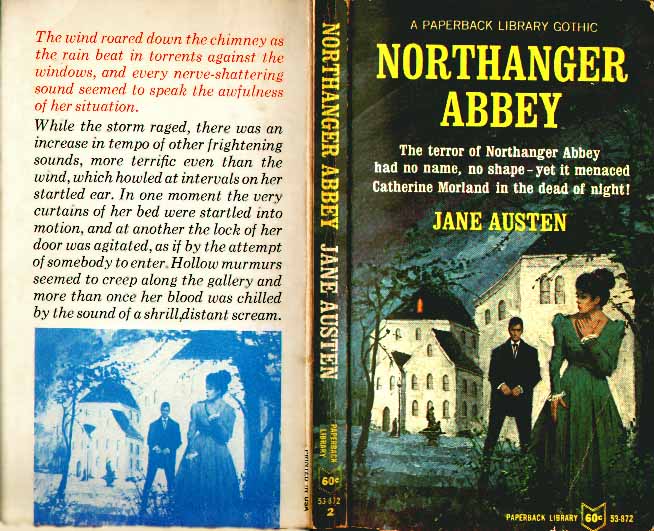

In this context, Austen’s concern with her characters’, and, in fact, her own readers’ ability to evaluate forms is unsurprising. Northanger Abbey tells the story of seventeen-year-old Catherine Morland’s first visit to Bath, where she is introduced into society for the first time and meets two important figures: Henry Tilney, an eligible young clergyman with whom she is quickly infatuated, and Isabella Thorpe, a young woman who befriends Catherine and introduces her to the gothic novel. This subgenre of the novel had risen to prominence in the 1790s and was perceived as a genre often written and almost always read by women. It was also criticized by many as having completely unrealistic plots that depended upon the same generic tropes and characters regardless of who wrote it. If those frontispieces are anything to go by, this may have been fairly valid criticism; nonetheless, Catherine’s fascination with the gothic novel leads her to believe that her own life ought to be full of supernatural mysteries and horrifying set-pieces—skeletons, dark corridors, ancient castles, and abbeys.

When Catherine is invited to visit with Henry Tilney and his sister Eleanor at their home, Northanger Abbey, she’s certain that her own gothic adventure is just beginning. She expects from the first moment of her visit that

Something was certainly to be concealed; her fancy, though it had trespassed lately once or twice, could not mislead her here; and what that something was, a short sentence of Miss Tilney’s, as they followed the General at some distance down stairs, seemed to point out:—“I was going to take you into what was my mother’s room—the room in which she died—” were all her words; but few as they were, they conveyed pages of intelligence to Catherine. (NA Vol. II Ch. VIII)

The logic is simple: if Catherine were in a gothic novel, the phrase spoken to her by her friend Eleanor would have suggested foul play. In this case, it leads Catherine to believe that Henry and Eleanor’s mother, dead for nine years, was actually murdered by their father, General Tilney. Austen uses this assumption to cannily represent the way in which genre can function as shorthand for the reader; a “short sentence,” translated through Catherine’s gothic imagination, results in “pages of intelligence,” which, though ultimately incorrect when applied to the real world, would be a perfect fit for one of the novels Catherine reads.

It takes Henry Tilney’s horrified response to Catherine’s assumption to show her that she isn’t living inside one of her novels. He catches her exploring his mother’s old room and reacts with shock when she questions him about the circumstances of the late Mrs. Tilney’s death, ultimately chastising her into seeing sense. Against the “dreadful nature of the suspicions [Catherine] has entertained,” Henry juxtaposes a “sense of the probable” and “observation of what is passing” in the real world (NA Vol. II Ch. IX). He draws a distinction between the form of the gothic novel and the form of life, and seems to deny any crossover between the two.

Although at first glance it might appear that Henry Tilney is the “good reader” we have all been waiting for, who will teach Catherine how to distinguish between the forms of fiction and reality, a closer look reveals that both Henry and Catherine go out of their way to make real life conform to conventional expectations. The only difference is that Catherine unreservedly inhabits the tropes of the gothic novel, while Henry’s knowing deployment of social rituals calls attention to the unnaturalness of the forms he follows.

Henry and Catherine’s first conversation revolves entirely around Henry’s understanding of what is “proper” for dance partners who have just been introduced:

After chatting some time on such matters as naturally arose from the objects around them, he suddenly addressed her with—“I have hitherto been very remiss, madam, in the proper attentions of a partner here; I have not yet asked you how long you have been in Bath; whether you were ever here before; whether you have been at the Upper Rooms, the theatre, and the concert; and how you like the place altogether. I have been very negligent—but are you now at leisure to satisfy me in these particulars? If you are I will begin directly.”

“You need not give yourself that trouble, sir.”

“No trouble I assure you, madam.” Then forming his features into a set smile, and affectedly softening his voice, he added, with a simpering air, “Have you been long in Bath, madam?” (NA Vol. I Ch. III)
Thus begins a series of rote questions that one assumes to be a sharp contrast to the conversation Henry and Catherine had been engaged in previously. Instead of discussing “such matters as naturally arose from the objects around them,” Henry’s new mode of conversation is “set” and “affected”—in other words, quite unnatural—but he insists upon going through with it because it represents the “proper attentions” that must be expressed. The text draws attention to the fact that this necessary conversation, carried out completely in keeping with conventional forms, doesn’t actually say much of anything.

This returns us to one of the first questions we asked: if Austen had no moral qualms about circulating libraries or novels, why present the circulating library as a place for Lydia to gossip, and the novel as a form that can be read from its cover? Given the evidence, it becomes clear that Austen is not criticizing the form of the novel as much as she is criticizing those who can’t look past or through the form to evaluate the substance and reality it encodes. Texts like Northanger Abbey and Pride and Prejudice allow Austen to critique readers who place their faith in outward forms, ranging from gothic frontispieces to uniformed soldiers to established social conventions. Austen inhabits the form of the novel in order to draw attention to the formulae which govern novelistic presentation of scenes and characters. She engages in a calculated deployment of common novel tropes in such a way that their status as tropes is called attention to. In this way, she makes her readers aware of their own expectations of form and genre by subtly upsetting those expectations.

Thursday, July 29, 2010

Deciphering Henry Tilney

I read Northanger Abbey for the first time slightly over a month ago in preparation for my senior thesis on Jane Austen and the form of the novel, and ever since then I’ve been going back and forth about what I think of the novel’s purported “hero” Henry Tilney. I find the protagonist Catherine to be simple in a cute sort of way—strong-minded and genuine in her opinions even when she’s not willing to speak up and assert them, young and a bit naïve but without it being really infuriating—but Henry is a mystery that I just can’t seem to wrap my mind around.

Part of this, I suspect, can be blamed upon the BBC. I hadn’t read Northanger Abbey a month and a half ago, but I had seen the 2007 TV movie starring Felicity Jones and J. J. Field. I’d found it to be much like its heroine (short, cute, fun), and almost like Pride and Prejudice lite (all the wordplay and banter but none of the ferocious arguments or long-held grudges). In the film, Field’s Henry Tilney is affable, and he delivers his character’s more questionable lines with a smile that makes you forget that he’s not making sense. I bought into Tilney’s silliness as a result of the film, and went into the novel expecting to find him, if nothing else, a good match for Catherine, willing to tease her and challenge her in such a way that would promote their developing relationship as well as the intelligence of both individuals.

I came away from my first reading of the novel with a pretty favorable account of him. He was a little more jokey, and a little more likely to cut others off for the sake of expressing his own intelligence, than I had expected, but his playful humor left me feeling that he was, in a strange way, a male prototype for Elizabeth Bennet. The language used to describe them is, in fact, incredibly similar. Henry is introduced as having “a very intelligent and lively eye,” “fluency and spirit,” and “an archness and pleasantry…which interested” (NA Vol. I Ch. III). In comparison, Darcy relates that Elizabeth’s countenance “was rendered uncommonly intelligent by the beautiful expression of her dark eyes” (P&P Vol. I Ch. 6), with “a mixture of sweetness and archness in her manner which made it difficult for her to affront anybody” (P&P Vol. I Ch. 10). Just as Henry teases Catherine by asking her a series of rote questions about her enjoyment of Bath, Elizabeth pursues conversation-by-formula with Darcy during their dance at the Netherfield ball. They are both witty jokesters who wouldn’t be able to stand having many acquaintances at whom they were not allowed to laugh.

But where Elizabeth’s mocking laughter is tamed (at least a little) by her increasing concern for Darcy’s feelings, Henry’s wordplay remains primarily unchecked, and herein lies my problem. Upon a second reading of key passages, I found myself running across instance after instance in which Henry’s wordplay, rather than seeming playful and ridiculous, began to appear authoritarian, a method to prevent others from speaking their minds rather than a way of encouraging light and easy conversation. Take, for example, a conversation between Henry and Catherine, in which Catherine speaks first:

“I do not understand you.”

“Then we are on very unequal terms, for I understand you perfectly well.”

“Me?—yes; I cannot speak well enough to be unintelligible.”

“Bravo!—an excellent satire on modern language.” (NA Vol. II Ch. 1)

On a first reading, the English major in me saw those last two lines as a frankly brilliant satire on modern language, but upon re-reading, I realized that Henry is talking more to amuse himself than to enlighten or entertain his conversational partner, who honestly doesn’t understand what he means. When he interprets her confused (and possibly annoyed) remark as satire, he is applying his own reading to the situation, for his own sake. Henry Tilney certainly speaks well enough to be unintelligible.

But even when he’s intelligible, his manner of talking isn’t always agreeable. He calls his sister “stupid” to her face and seems to consider it as an endearment (or at least not an offense); Eleanor is clearly used to this kind of address, and therefore keen to make sure Catherine doesn’t take her brother too seriously. Frankly, under these conditions, I’m surprised that Catherine manages to take him seriously enough to fall in love with him. He takes over topics of conversation introduced by her and does his best to direct them toward his own experience and interests; when Catherine cuts him off from extolling himself for being so well-read, he retaliates by quarreling with her diction:

“But now really, do not you think Udolpho the nicest book in the world?”

“The nicest;—by which I suppose you mean the neatest. That must depend upon the binding.”

“Henry,” said Miss Tilney, “you are very impertinent. Miss Morland, he is treating you exactly as he does his sister. He is for ever finding fault with me, for some incorrectness of language, and now he is taking the same liberty with you. The word ‘nicest,’ as you used it, did not suit him; and you had better change it as soon as you can, or we shall be overpowered with Johnson and Blair all the rest of the way.” (NA Vol. I Ch. 14)

Again, Eleanor must step in to assure Catherine that this man of her dreams isn’t really as rude and obnoxious as he seems—but even as she does so, she encourages Catherine to “change” her diction to suit Henry’s tastes. It’s obvious that Eleanor’s spent too much time with her brother, and has given up opposing him in these petty arguments. Some people might think this saintly of her, but I identify too much with the fierce and sprightly Elizabeth Bennet to find the idea of forbearance terribly appealing in this instance. (As a side note, when working on my thesis over the past few days, I’ve found my thoughts continually interrupted by a scene of Elizabeth Bennet and Henry Tilney meeting on the dance floor after their respective marriages and sharing an intriguing and flirty power-play of a conversation before going their separate ways. In case you were wondering, in my head it’s a power-play Elizabeth undeniably wins.)

All of this has left me asking myself a question I simply can’t answer: why does Catherine marry him?

The problem with this question is that it’s more a question of theme than of character. I can understand completely Catherine’s attraction to Henry Tilney; it’s one that I felt acutely the first time I read this novel, and in a world of limited options and minimal power for women, perhaps I would have made a similar choice. What I can’t understand is what their marriage means on a larger level—what Austen is trying to get at. I’m of the opinion that marriages in Austen’s novels pull a lot of thematic weight in addition to what they do for the plot and the form. I’m convinced that, on a metaphorical scale, the marriage of Elizabeth and Darcy singlehandedly averts the French Revolution from happening again on English soil (there may be more about this conviction in a future post); Elizabeth herself suspects that her marriage could “teach the admiring multitude what connubial felicity really was” (P&P Vol. III Ch. 8), and I don’t think this is an overstatement.

But what do Henry and Catherine have to teach us? Why should the admiring multitudes even give them a second look? Henry Tilney would probably be quite happy at the idea of teaching others; many of his interactions with Catherine are didactic in nature, intended as correctives to her overactive imagination or supplements to her aesthetic education. He seems destined to become the husband-as-teacher, with Catherine as a perfect and eager student, but their intellectual relationship seems sadly one-sided, a conversation in which one voice will always overpower the other. Perhaps, in time, Catherine will learn (as Eleanor has already learned) to stop speaking out, to laugh at her husband’s outlandish assertions rather than to challenge them. But I can’t help but think that she deserves a better future than this, and so I can’t help but wonder if there isn’t something I’m missing, about Henry or Catherine or the whole scale of the novel, that would set this all right.